
How to Search Criminal Dockets
Qualifying Morehouse criminal cases start at the state level, through eClerks LA Criminal Search. The Morehouse Parish Clerk of Court holds the local district-court record. The office also links to Clerk Connect for parish case and document access. For hearing dates, the Fourth JDC Docket and Schedules pages add a public setting layer. Each route has its own job. The state layer gives a criminal-minute lead. The clerk route supplies the file and copies. The calendar confirms the court date.
Always search by the complete case number if you have it. Without one, narrow things down with the responsible court, a reliable name spelling, the right date range, and the case category. Keep in mind that a weekly court docket is a date-specific list, not a full criminal archive. A missing result can mean several things. A different court may hold the case, or the record may be older. An access limit may apply. Or the search tool simply does not reach that record.
- Confirm that the matter is a Fourth JDC Morehouse criminal case rather than a city, mayor's-court, JP, traffic, or federal matter.
- Use eClerks LA Criminal Search for qualifying statewide criminal-minute information.
- Check Clerk Connect through the Morehouse Clerk for available local record and document access.
- Review the Fourth JDC schedules and weekly docket for the current or next court setting.
- Request the specific Morehouse minute, pleading, copy, or certification from the clerk when the public result is incomplete.
Morehouse Criminal Docket Search Layers
eClerks LA is a statewide access layer, not a universal file cabinet. Its home page separates the free Statewide Portal from Parish Search functions. Those parish functions may involve subscriptions and image access, and the site also advertises Criminal Search. The exact criminal search fields are not documented here. So do not assume the civil Statewide Portal fields match them. Treat any eClerks result as a lead toward the Morehouse court record, not a complete case file.
Clerk Connect is the Morehouse Clerk's parish portal. Its public landing page is mainly a login gate, though. Search fields, image coverage, account requirements, and charges should be confirmed in the live system before you rely on them. To compare the parish and statewide tools, the Morehouse Parish case search route lays out both options side by side.
What a Criminal Docket Shows
A Morehouse Parish criminal docket blends two things: calendar data and short event summaries. Pull the pieces that matter most. Case number, court section, charge stage, setting date and label, minute or filing description, next setting, and recorded disposition all help you track the case. Each source has a blind spot. A court calendar can list an arraignment or criminal docket setting without saying how it ended. A minute summary reports the outcome, but it skips the fine detail of that hearing. Read them side by side. Copy the exact court section and event date as you go.
| Case number | The Morehouse court identifier. Official Morehouse displays include compact formats such as 2024-249 and N-23-86; do not decode a prefix without clerk confirmation. |
|---|---|
| Charge stage | The Morehouse arrest or summons, bail, charge filing or amendment, arraignment, motion, trial, plea, or sentence stage. |
| Setting details | Morehouse date, time, courtroom or location, judge, court section, and label such as Criminal Docket or Felony Arraignment. |
| Minute entry | A Morehouse clerk-maintained summary of the court event. It is not a transcript and may not contain every filed document. |
| Disposition | The exact Morehouse result recorded in a later minute, order, judgment, or case record, not an inference from a calendar entry. |
Morehouse Criminal Minute Fields
La. R.S. 13:5992 puts a duty on the district clerk. Criminal cases filed on or after January 1, 2020 must get electronic public access through the LCRAA system, either as qualifying minute entries or a summary. The listed categories run from arrest or summons and custody or bail, through the charge, a hearing or motion, and trial or adjudication, to guilt, sentence, date, judge, prosecutor, and defendant. Not every document image has to appear there, though. The statute only reaches minutes and summaries.
Traffic tickets sit outside this minute-access rule. That line matters in Morehouse, since Title 32 and other citation-based matters can take a distinct route under local Rule 14.0B. So a traffic citation calls for a docket check in a different place. Follow the citation itself: it may point to the issuing court, the Fourth District Attorney traffic instructions, a city court, a mayor's court, or the Fourth JDC calendar.
For the Morehouse public-minute access description, the official criminal-access statute is where the rules come from.
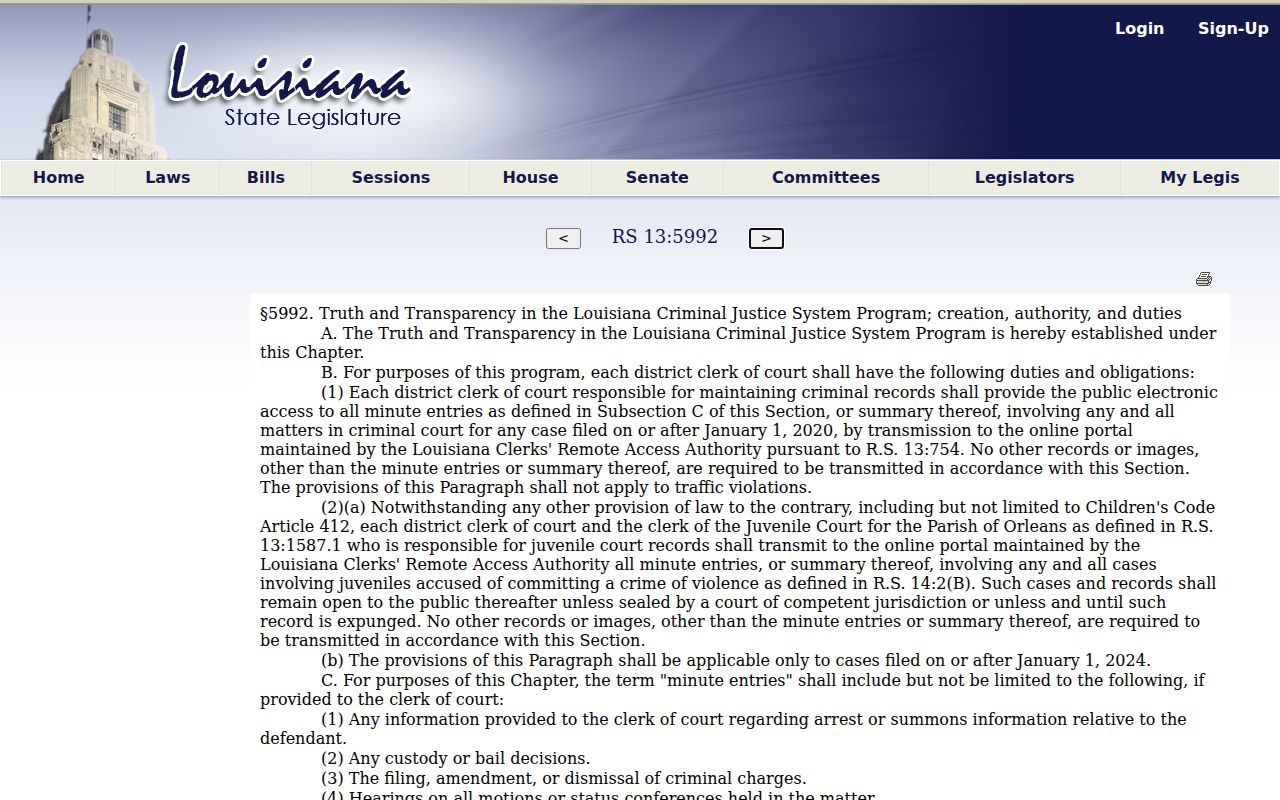
The law confirms a limited scope. A Morehouse Parish criminal minute summary covers set categories only, so it is not automatically a complete collection of the case documents.
Stages on a Criminal Docket
A criminal case usually moves through distinct court events. A Morehouse Parish case may skip stages, though. Motions, continuances, or related proceedings can shuffle the order. Treat the public docket as a timeline of recorded court events, not a short story. A setting can appear first. Only a later entry tells you whether the event happened or moved. The complete minute entry and any resulting order control how the outcome is described. Check them before drawing conclusions from the docket alone.
Morehouse criminal docket flow: Arrest or summons → charge filed → arraignment → pretrial or motion setting → plea or trial → disposition → sentencing or later post-conviction event.
Morehouse Criminal Duty Docket Settings
Need a future duty date or a felony arraignment date in Morehouse Parish? The Fourth JDC posts a Morehouse Criminal Duty Schedule each year. Separate links cover felony arraignments. Weekly docket sheets from the court carry their own labels. Examples include 72 Hour Hearings or Criminal Docket. Read those labels with care. A 72-hour hearing and a felony arraignment can sit on the same court calendar. Yet they signal very different steps in a criminal docket.
| Published setting | What it indicates | What to confirm |
|---|---|---|
| 72 Hour Hearings / Criminal Docket | A Morehouse prompt custody or probable-cause-related criminal setting | Morehouse minute entry, section, and any later setting |
| Felony Arraignment | A Morehouse formal felony-stage appearance | Morehouse charge instrument, plea, counsel, and next date |
| Criminal Docket | A Morehouse general criminal docket call or scheduled criminal matter | Morehouse case number, judge, courtroom, and result |
| Trial | A Morehouse trial setting | Later Morehouse minutes, verdict, judgment, and disposition |
Note: A published Morehouse setting confirms when a hearing is set. It shows no plea, no dismissal, no custody result, and no conviction.
Which Court Holds Criminal Dockets
District criminal work in Morehouse Parish belongs to the Fourth JDC. Its five numbered sections split the load. Criminal and civil assignments rotate among them. Yet each judge keeps general jurisdiction over the whole court docket. Rule 14.0 governs how criminal cases get allotted. Random allotment is the norm. Citation-based cases, related matters, probation issues, wildlife cases, and recusals get their own treatment under the rule. The Morehouse Clerk keeps the district court record itself. The Fourth JDC publishes the schedule a searcher actually sees. Municipal matters run separately. Bastrop City Court maintains its own criminal and traffic docket. Bonita, Collinston, Mer Rouge, and Oak Ridge each handle ordinance cases through a mayor's court. A federal charge lands in the Western District of Louisiana's Monroe Division, reached through PACER or the federal clerk. Pick the wrong venue and the Morehouse court docket simply will not show up where you expected it.
Morehouse Criminal Court Venue Map
Matching the case to the right court saves the most time. A Morehouse felony or other district charge starts with the Fourth JDC and the clerk's office. A Bastrop city violation belongs to Bastrop City Court. Village ordinance citations go to the issuing mayor's court. Those records do not flow into the parish clerk's district docket on their own. A state-law traffic ticket takes a different route. It goes through the DA and the issuing court, not a generic criminal-minute query, when the Fourth District Attorney prosecutes the ticket. For assignments, schedules, and criminal allotment, the 4JDC local rules are the official word. The Fourth JDC court-rules index collects the local appendices. It also gathers the statewide rules that govern the court.
The rules page backs up the venue analysis above. For pinning down an exact court section, nothing beats a case number and the actual filing.
Public Access and Sealed Criminal Dockets
Open Morehouse district-court records are read through the Morehouse clerk or an approved electronic system, within statutory limits. A blank result online is not proof of sealing. Several categories carry their own Morehouse access rules. Juvenile records and sealed or expunged files sit apart from ordinary public access. So do protected family matters and protected-identifier materials. Criminal-minute access is also narrower than access to every criminal document. It never reaches traffic cases.
Morehouse criminal access limits.
La. C.C.P. art. 251 makes the Morehouse clerk custodian and supports examination, copying, and certification of open records.
La. C.C.P. art. 253 requires Morehouse protection of specified personal identifiers in filed and electronic records.
La. R.S. 13:5992 provides Morehouse public electronic criminal-minute access for qualifying cases while excluding traffic violations.
Morehouse Criminal Docket Copy Fees
The Morehouse Clerk's posted criminal fee schedule lists the charges for research and copies. The search fee covers actual research time only. Copies and certifications cost extra. Since fees can change, confirm the current amount and accepted payment method with the clerk before mailing anything. Civil and municipal requests draw on a different fee authority. The criminal list should stay with criminal requests.
| Morehouse criminal request | Posted amount |
|---|---|
| Morehouse research search | $20 per name |
| Morehouse copy | $1 each |
| Morehouse certified copy | $5 each |
| Morehouse conformed copy | $3 each |
| Morehouse extract of minutes | $10 each |
| Morehouse certified minute extract | $15 each |
Morehouse Drug Court Calendar
Drug Court is its own stop on a Morehouse criminal docket search. Eligibility under R.S. 13:5301-5304 runs through recommendation, permission, and acceptance under the Fourth JDC local rules. If a person is not accepted, the case can return to its original section. The Fourth JDC schedule serves as the public calendar source. The court offers no standalone Drug Court case-search portal. That means the clerk-held court record and the schedule carry the load. One caution matters here. A Drug Court setting or enrollment entry does not establish a conviction, completion, or any later case result. Check the underlying minute information before describing the event. Confirm it against the current schedule too.
Morehouse Criminal Case Numbers
Morehouse docket displays follow a year-number pattern, with at least one N-23-86 style in view. The public materials do not assign a fixed meaning to every digit or prefix. So search the whole displayed number first. If that fails, drop the punctuation. You can also search by party name and year where the system allows it. Keep the Morehouse court and section attached to the number. One schedule can list several kinds of criminal setting in a single document.
Morehouse Criminal Filing Context
The 2023 Louisiana Supreme Court annual report counted 1,246 Morehouse district criminal filings. That came out of 5,974 total district filings. The same report lists 3,965 traffic, 495 civil, and 268 juvenile filings. These are workload numbers, nothing more. They are not convictions, outcomes, or names. They do explain why a Morehouse criminal docket has to be separated from traffic and other categories before anyone reads a record into it.